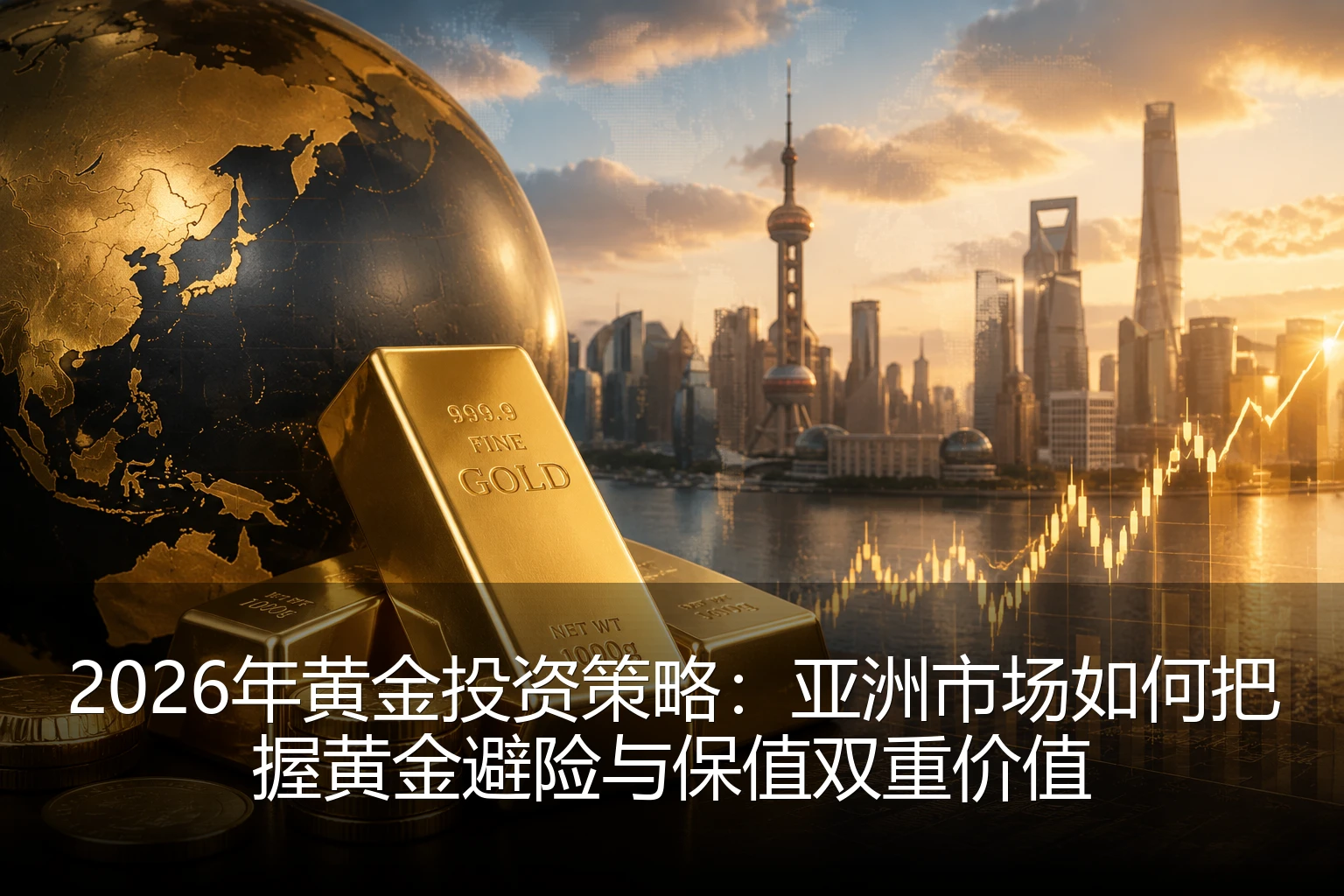



New Era of Gold Investment: Why the Logic for Buying Gold in Asian Markets is Stronger in 2026
\n\nIn 2026, as the global economic landscape continues to experience turbulence, gold as a traditional safe-haven asset once again demonstrates its unique charm. In the Asian region, particularly in China, India, and Southeast Asian countries, gold demand continues to rise, reflecting not only investors' urgent need to hedge against inflation and geopolitical risks but also revealing the strategic value of gold in global asset allocation. This article will analyze the investment logic of the Asian gold market in 2026 from multiple dimensions, helping investors understand why gold has become an indispensable part of asset allocation in the current market environment.
\n\nI. Gold Value Reassessment in the Global Macroeconomic Environment
\n\nIn 2026, the global economy is in a complex situation with multiple challenges intertwined. Although major developed economies have avoided recession, their growth momentum has significantly weakened, and inflationary pressures persist. Meanwhile, global debt levels continue to rise, geopolitical conflicts occur frequently, all of which provide solid support for gold as a safe-haven asset.
\n\nAccording to the latest data from the International Monetary Fund (IMF), global public debt in 2026 has reached 98% of global GDP, a historic high. Against this backdrop, central banks worldwide are accelerating reserve diversification, reducing dependence on the dollar, and increasing gold reserves. Asian central banks have been particularly active in this trend, with gold purchases in the first half of the year increasing by 35% year-on-year, a historic high.
\n\nThe comparative advantage of gold over negative-yield bonds is also becoming increasingly prominent. In 2026, although the global scale of negative-yield bonds has fallen from its peak, it remains at the $15 trillion level. This means that investors holding these bonds are essentially "paying" for a safe asset, whereas gold does not require paying a "negative yield" while maintaining the characteristics of a physical asset.
\n\nII. Structural Changes in Asian Gold Demand
\n\nThe Asian region has always been the main driver of global gold demand, and this trend has further strengthened in 2026. Gold consumption in China, India, and Southeast Asian countries accounts for over 60% of the global total, showing a diversified demand structure.
\n\n- \n
- Continuously Growing Consumer Demand: Gold sales data from traditional Indian festival seasons and Chinese New Year shows that physical gold demand increased by 12% year-on-year, indicating the continued solid position of gold in Asian culture. \n
- Diversified Investment Demand: In addition to traditional gold bars and coins, investment tools such as gold ETFs and gold accounts are becoming increasingly popular in Asian markets, providing diverse options for investors with different risk preferences. \n
- Rise of Digital Gold: The development of blockchain technology has given birth to digital gold products, allowing investors to participate in the gold market at a lower threshold, attracting a large number of young investors. \n
Another significant feature of Asian gold demand is the increased participation of institutional investors. Large institutions such as pension funds and sovereign wealth funds are increasing their gold allocation ratios from the traditional 5% to 8-10% to achieve portfolio diversification.
\n\nIII. Strategic Considerations Behind the Central Bank Gold Purchase Surge
\n\nIn 2026, global central bank gold purchases reached an unprecedented level. According to data from the World Gold Council, global central bank gold purchases totaled 500 tons in the first half of the year, a 40% increase year-on-year, marking the 21st consecutive month of net gold reserve accumulation. This trend is particularly evident in Asia, with central banks in China, India, Turkey, Poland and other countries actively increasing their gold holdings.
\n\nThe strategic considerations behind central bank gold purchases mainly include:
\n\n- \n
- De-dollarization: As the dollar's share in the international reserve system gradually declines, central banks seek reserve diversification, with gold becoming an ideal alternative asset. \n
- Geopolitical Risk Hedging: Against the backdrop of intensifying geopolitical risks such as the Russia-Ukraine conflict and Middle East tensions, gold, as a depoliticized safe-haven asset, is favored. \n
- Currency Credit Guarantee: When fiat currencies face depreciation pressure, gold as a physical asset can provide credit guarantees. \n
Continuous central bank gold purchases not only provide solid bottom support for the gold market but also send strong positive signals to the market, further strengthening gold's position as a strategic asset.
\n\nIV. Strategic Position of Gold in Personal Asset Allocation
\n\nFor individual investors, gold plays an indispensable role in asset allocation. In 2026, with increasing market volatility and a more complex investment environment, the strategic value of gold has become even more prominent.
\n\n1. Safe Haven Function\n\n
Gold has low correlation with traditional financial assets and can provide protection during market turmoil. In the first half of 2026, against the backdrop of increased global stock market volatility, gold performed relatively stably, maintaining a low correlation coefficient of around 0.1 with major stock indices, effectively diversifying portfolio risks.
\n\n2. Value Preservation and Appreciation\n\n
Despite short-term price fluctuations, gold's long-term value preservation capability has been historically verified. Over the past 20 years, gold's annualized return has been about 5%, comparable to global GDP growth, while its volatility is much lower than that of the stock market. In an inflationary environment, gold's performance is particularly outstanding. In the first half of 2026, against a global inflation rate of 3-4%, gold's real return reached 2-3%.
\n\n3. Liquidity Advantages\n\n
The gold market is one of the most liquid commodity markets globally, with 24-hour trading and narrow bid-ask spreads, meeting investors' liquidity needs under different market conditions. Compared to traditional physical assets, modern investment tools such as gold ETFs have further improved liquidity, allowing investors to more flexibly adjust their gold allocation ratios.
\n\nV. Gold Investment Strategy Recommendations for 2026
\n\nBased on an analysis of the current market environment, we provide the following gold investment strategy recommendations for different types of investors:
\n\n1. Long-term Investors\n\n
For long-term investors, we recommend adopting a "core-satellite" strategy, allocating gold as a core component of the portfolio, accounting for 5-10% of total assets. This can be achieved through regular fixed-amount investments to smooth market volatility risks and hold for the long term.
\n\n2. Medium-term Tactical Allocation\n\n
For medium-term investors, gold allocation ratios can be flexibly adjusted according to economic cycles and market conditions. When economic uncertainty increases and monetary policy shifts to easing, gold allocation can be increased to 15%; when economic growth stabilizes and monetary policy tightens, the allocation ratio can be appropriately reduced.
\n\n3. Short-term Traders\n\n
For short-term traders, technical analysis tools can be used to seize opportunities in gold price fluctuations. Key driving factors such as the US dollar index, real interest rates, and geopolitical events should be focused on, adopting trend-following strategies to participate in the market.
\n\nVI. Risk Management in Gold Investment
\n\nAlthough gold has multiple advantages, investors still need to recognize the risks of gold investment and take appropriate risk management measures:
\n\n- \n
- Price Volatility Risk: Gold prices may fluctuate significantly in the short term, and investors should allocate reasonably according to their own risk tolerance. \n
- Opportunity Cost: Gold does not generate interest or dividends, so holding gold incurs opportunity costs. \n
- Liquidity Risk: Physical gold has relatively low liquidity, and liquidation may face certain difficulties. \n
- Storage Security Risk: Physical gold needs proper storage and faces risks of theft or damage. \n
To effectively manage these risks, investors can adopt diversified allocation strategies, combining gold with other asset classes; choose formal gold investment channels to ensure transaction security; and regularly adjust investment strategies based on market changes to maintain flexibility.
\n\nVII. Future Outlook: Long-term Trends in the Gold Market
\n\nLooking ahead, the gold market faces multiple development opportunities and challenges. In the long term, the following trends deserve attention:
\n\n- \n
- Continuation of Central Bank Gold Purchase Trend: As the trend of global reserve diversification strengthens, central bank gold purchases are expected to continue, providing solid support for gold. \n
- ESG Investment and Gold: As the concept of sustainable development becomes more deeply rooted, gold as an environmentally friendly asset will receive more attention. \n
- Technological Innovation Driving Market Development: Technological innovations such as blockchain and artificial intelligence will improve the efficiency and transparency of the gold market, attracting more investors to participate. \n
- Rise of Asian Markets: With the enhancement of Asian economic strength and financial market development, Asia's influence in the global gold market will further increase. \n
Overall, the gold market in 2026 shows characteristics of strong supply and demand and diversified demand. Against the backdrop of increasing global economic uncertainty, the strategic value of gold as a safe-haven asset and value preservation tool has become even more prominent. For Asian investors, seizing investment opportunities in the gold market can not only effectively hedge risks but also achieve stable returns in long-term investments.
\n\nAs investment legend Warren Buffett said: "Gold isn't going to do anything for you, but it won't bother you either." In a complex and changing market environment, gold may be exactly the asset that investors need - "one that won't bother you." Through scientific asset allocation and risk management, gold is expected to become an important tool for investors to preserve and increase their wealth.