


Will the S$59 Shrimp Paste Buffet Hotpot Become the Next "Beef Rib Buffet"?
S$59 per person for shrimp paste buffet hotpot — have small-town young people finally achieved "shrimp paste freedom"? On a recent trip home, I noticed several shrimp paste buffet hotpot restaurants had opened in a second-tier city in Hebei.
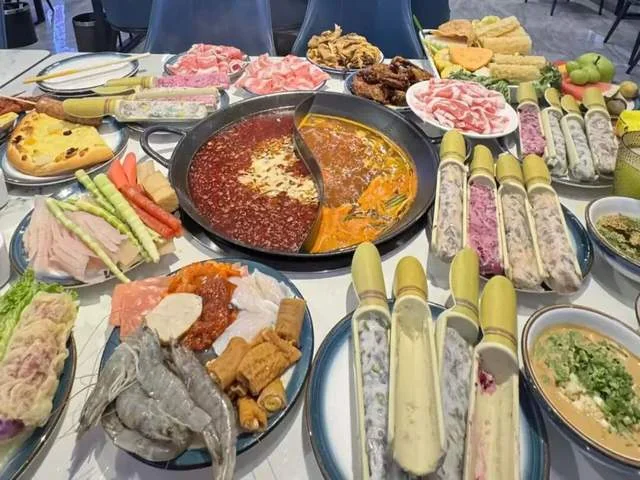
Compared with a regular hotpot buffet, this place is basically a "shrimp paste museum": from original shrimp paste to caviar shrimp paste, shiitake shrimp paste, squid shrimp paste, and even dragon fruit shrimp paste, there are more than a dozen varieties.

In addition to shrimp paste, the restaurant also offers chicken paste, beef paste, fish paste, and other "paste derivatives," all packed in bamboo-tube containers and lined up in several rows in the refrigerated display case, quite a spectacle.

Besides shrimp paste, the restaurant also has traditional hotpot items such as beef and lamb, vegetables, and mushrooms, as well as desserts, drinks, and ice jelly that you would expect from a standard hotpot buffet. Some stores even add staples like pizza.
Of course, most customers are there for "shrimp paste freedom."
Shrimp Paste Buffet Hotpot Chains Expand: From Hebei to More Provinces
In fact, over the past year, a number of chain shrimp paste buffet hotpot brands have emerged in Hebei alone, and some have successfully expanded beyond the province.
For example, Shijiazhuang-based Cijie Freshly-Pounded Shrimp Paste Old Hotpot, founded last year, now has 66 stores and has expanded to Shandong, Jilin, and Jiangsu. Another Hebei brand founded in the same period, Chenkebei Shrimp Paste Buffet Old Hotpot, has opened nearly 40 stores across Hebei, Shanxi, Heilongjiang, and Jilin.

Jiang Laolao Shrimp Paste Seafood Buffet Hotpot, which opened its first store in Zhejiang, now has a footprint across 12 provinces nationwide and opened 20 new stores this year alone. Founded in 2018, Lao Xiaoxian Shrimp Paste Seafood Buffet Hotpot also accelerated expansion last year, with 40 new stores opened since 2025.
The category has become so popular that it has even spread to South Korea. Recently, some netizens posted that South Korea now has shrimp paste buffet hotpot too, with a "bamboo tube + shrimp paste" setup almost identical to China's.

Why Shrimp Paste: Growth Driven by Market Value and a Strengthened Supply Chain
There are many reasons for the rise of shrimp paste buffet hotpot.
On one hand, shrimp paste has become more widely used across the catering industry and is already a classic heavyweight item in the hotpot sector. Data from retail monitoring network Maishangying show that in 2025, sales revenue in the shrimp paste category rose 56.9% year on year, while sales volume increased 60.6%, ranking first among frozen food subcategories in growth.
In Zhejiang, Jiangsu, Anhui, Hunan, and Guizhou, shrimp paste even "overtook" beef balls to become the No. 1 hotpot ball-and-paste category locally.

On the other hand, shrimp paste carries a premium image that matches consumers' expectations of getting their money's worth. Despite its popularity, this frozen product star is not cheap. For example, at Haidilao, a signature large-granule shrimp paste (about 140g) costs S$74. Even in supermarkets, a pack of Anjoy shrimp paste can cost S$16.5 per 150g.
Against that, eating a few servings of shrimp paste at a buffet hotpot restaurant can more than offset the S$59 entry fee. Add a few more items and you can "break even," which is highly appealing.

Most importantly, the upstream shrimp paste supply chain has become stronger, with rising production technology and output. Take Daxiajiji as an example: focusing on a single shrimp paste category, it led the drafting of the group standard for "Shrimp Paste" in 2023 and the national standard for "Frozen Shrimp Paste" in 2024. It now sells more than S$100 million a month and has annual sales of over S$1 billion.
For catering, especially the hotpot sector, the upstream supply chain is the core lifeline for brands to cut costs, improve efficiency, and secure quality. The rise of this shrimp paste supply chain has also created the conditions for shrimp paste buffet hotpot to emerge.

Will It Become the Next "Beef Rib"? Costs Are Controllable, But Operations and Differentiation Still Matter
According to Chenzhi Data, over the past year, the number of shrimp paste buffet outlets has grown rapidly from fewer than 10 to more than 500, mainly in lower-tier markets.
Building differentiation around a single-item buffet model and opening stores quickly in a short time inevitably reminds people of the similar "beef rib buffet." That format boomed rapidly in the second half of 2024, only to see a wave of closures in early 2025; some operators even lost more than S$2 million in just three months.
Of course, unlike beef rib buffets, which opened when beef prices fell and later closed as beef prices rose, shrimp paste costs are relatively controllable, and the development of the upstream supply chain has also strengthened the category's foundation.
But it is worth noting that ingredient costs can only be the final straw for the beef rib model. Another big reason those stores faltered was that most of them merely rode the viral "beef rib" trend without turning category popularity into brand repeat business, and ultimately had to exit a homogenized market.
For these emerging shrimp paste buffet hotpot brands, the test of brand differentiation, product innovation, and store operations still remains. Whether they can scale sustainably is still something to watch.